Top 5 Tips for RISK FREE Flirting (For Men)

conversation starters, social skills, networking tips, deep conversation questions, small talk alternatives

Namskar, Anshu here and I want to show you how you can dramatically increase the amount of opportunities and attraction you are getting in your love life by showing you five tried and tested flirting techniques that not only work, but are subtle enough that you won’t have to risk looking desperate or getting painfully rejected while trying them. These strategies will help you create meaningful connections while staying true to yourself. Let’s dive into how to flirt confidently without fear of embarrassment.

Why Flirting Feels Risky (And How to Overcome It)

Our fear of how we will look when we try to flirt and the idea of it going wrong can make us spend our lives playing it safe. Especially when it comes to the people we really like, which is understandable because we know it is their rejection that will hurt the most. And because if it goes wrong, we will have to move countries and there is still 6 months left on our apartment lease. But playing it too safe can mean missing out on real opportunities where something could have blossomed, leaving you with the nagging feeling that your single status might partly stem from holding yourself back.

These five flirting techniques are subtle, effective, and low-risk, allowing you to build attraction without overexposing yourself. Whether you’re at a social event, on a dating app, or trying to escape the friend zone, these strategies will help you make an impact. Let’s get started.


1. Do 5% More Than You Normally Would

To flirt without looking desperate, start by taking the word “flirting” out of your mind. Many of us connect flirting to sexuality, which can make us freeze up, fearing we’ll come across as creepy. Instead, think of flirting as turning on the engine of a car—engaging someone in a small, playful way. For example, if you’re standing in line next to someone who looks cold, you might say, “Oh, no. We should have brought bigger jackets, shouldn’t we?” This light-hearted comment is barely detectable as flirting—it could just be friendly. But it opens the door to connection with a playful openness.

Why It Works: Doing 5% more than you normally would feels big to you but subtle to others. It’s like using slightly more body language in a video—it feels over-the-top to you, but to others, it’s hardly noticeable. Start small to turn on the engine without risking rejection.


2. Switch to the Language of Tension

If you’re great at talking but nothing romantic comes of it, you might be missing tension. Conversation alone isn’t enough—conversation plus tension creates that “I have to see you again” spark. Tension comes from creating and closing space in a conversation. For example, if you’re chatting at an event and get separated, you can reinitiate later with, “Remind me to tell you about the greatest conversation I just had.” This reconnects in an intriguing, conspiratorial way.

How to Create Tension:

  • Close the space: Start a conversation, whether in person or on a dating app.
  • Recreate space: Step away briefly—talk to someone else or focus on your life (e.g., don’t text back immediately).
  • Close the space again: Reinitiate with a playful or intriguing comment.

Real-Life Example: Imagine bonding over shared skepticism of new-age beliefs. You get separated, and someone else mentions past lives. You lean over to the person you were flirting with and say, “Remind me to tell you about the greatest conversation I just had.” This creates tension by rekindling the connection.

Why It Works: Tension makes your presence more intensely felt. It’s not about playing games—it’s about balancing engagement with independence, which builds attraction.


3. Create a Shared World

A powerful flirting technique is creating a shared world—a private, exclusive connection between you and another person, like an inside joke or recurring gesture.

Real-Life Example: A friend shared how he and his girlfriend bonded over apples. In a class, he complained about being hungry, and she gave him an apple. The next day, he brought her an apple as a joke, starting a ritual where they’d surprise each other with apples, like serving apple slices at a party. This shared world signaled a connection and made their interactions fun.

How to Do It: Notice small moments with potential. If someone mentions something unique, like a love for a hobby, “yes, and” it by referencing it later. For example, if they mention a ski trip, bring it up playfully later to build a connection.

Why It Works: Shared worlds are attractive because they’re exclusive to you two. They require both people to recognize and build on a moment, signaling mutual connection. These “games” are fun and keep you present, a silent form of investment.


4. Practice Changing Gears

Attraction thrives on contrast, not monotony. If a conversation is stuck in one gear—whether high-energy chatter or low-energy monotony—it lacks chemistry. Flirting requires changing gears to create tension and excitement.

What to Avoid: On a date, avoid frenetic energy where you talk over each other, make excessive gestures, or never pause. This leaves no room for tension. Conversely, being too low-energy can make things lifeless.

How to Change Gears:

  • Speed up for excitement: Share a funny story or joke, hopping from one idea to the next.
  • Slow down for tension: Hold eye contact, speak deliberately, and let moments linger.

Real-Life Example: In a First We Feast YouTube video, Elijah Wood discusses sandwiches with a mix of serious, playful, and cheeky energy. His expressive reactions and shifts from serious to silly make him endearing and “flirtatious” without being overt. Comments noted his charm, like, “I have never found Frodo more attractive.”

Why It Works: Changing gears keeps the conversation dynamic and engaging, showing you’re present and adaptable, which is inherently attractive.


5. Notice Something in a Flirtatious Way

A subtle yet powerful technique is to notice something about a person and comment on it playfully. This isn’t about bold compliments but light, specific observations with a flirty energy.

Real-Life Example: On one of Matthew’s early dates with his wife, Audrey, she noticed he ordered spicy food and said, “I think it’s really attractive when someone likes spicy food. I think it says a lot about them.” She dropped this casually and moved on, making it subtle yet impactful.

How to Do It: Spot something unique, like art on their wall or an item in their dating profile. For example, if you see a Spirited Away poster, say, “Is that a Spirited Away picture on your wall? Well played.” If they ask why, respond, “Nothing. Just you went up a notch in my books without realizing it.”

Why It Works: These comments are low-risk, not overtly romantic, but carry a flirtatious energy that signals interest. They’re specific, making the other person feel seen.


What These Techniques Have in Common

All five techniques—doing 5% more, creating tension, building a shared world, changing gears, and noticing something flirtatiously—are low-risk and rejection-proof. They don’t involve bold declarations that put you on the spot. Instead, they’re about starting small and gradually turning up the temperature, like warming up a car. These strategies let you flirt naturally, building attraction without fear of embarrassment.


Flirt with Confidence

Flirting doesn’t have to be scary or overt. These five subtle techniques help you create attraction, build chemistry, and open the door to meaningful connections without risking rejection. Start small, create tension, build a shared world, change gears, and notice unique details. These strategies let you flirt confidently while staying true to yourself.

Share your thoughts or success stories in the comments below, and let’s keep the conversation going!

Arranged Marriage Process in New York City: A Comprehensive Guide

Love marriages, where individuals choose their partners based on mutual affection, often start with high romantic passion, which can lead to higher initial satisfaction. However, this can also set unrealistic expectations, leading to disillusionment when reality doesn’t match. A 2025 article discusses that love marriages may be more likely to end in divorce due to these expectations and emotional dynamics, especially with changing gender roles and individualism In contrast, arranged marriages adopt a more pragmatic approach, focusing on long-term compatibility, which seems to contribute to their lower divorce rates.

Key Points

  • Research suggests arranged marriages often have lower divorce rates, around 4% globally, compared to 40-50% for love marriages in Western countries.
  • It seems likely that family involvement and shared cultural values help arranged marriages succeed by providing support and reducing conflicts.
  • The evidence leans toward lower initial expectations in arranged marriages, allowing love to grow over time, which may contribute to their stability.
  • There is some controversy, as some studies note potential issues like lack of chemistry, but overall, arranged marriages appear more stable in terms of divorce rates

1. Introduction to Arranged Marriages

Arranged marriages, a practice deeply rooted in cultures like those of the Indian subcontinent, involve families or intermediaries selecting spouses based on shared values, cultural compatibility, and personal preferences. In New York City (NYC), a global hub of diversity, arranged marriages blend traditional practices with modern approaches, reflecting the city’s cosmopolitan nature. This guide explores the process for Indians and Westerners in NYC, detailing matchmaking services, matrimonial websites, legal requirements, and cultural considerations. It aims to provide a thorough roadmap for navigating arranged marriages in this vibrant urban setting.

1.1 Definition and Cultural Context

An arranged marriage is a union where families, often with the consent of the individuals, select a spouse based on criteria like religion, caste, education, or profession. In traditional settings, couples might meet briefly before the wedding, but in modern contexts, especially in NYC, individuals have significant input, often meeting multiple times or dating before deciding. For Indians, arranged marriages preserve cultural identity, while Westerners may pursue them for religious or familial reasons, though less commonly.

1.2 Traditional vs. Modern Arranged Marriages

  • Traditional Arranged Marriages:
    • Families control the selection process.
    • Limited interaction between couples before marriage.
    • Emphasis on caste, religion, and family status.
  • Modern Arranged Marriages:
    • Individuals have veto power and meet potential matches.
    • Technology, such as matrimonial websites, facilitates the process.
    • Focus on compatibility, education, and shared goals.

In NYC, modern arranged marriages dominate, with families using professional matchmakers or online platforms to find matches while respecting individual preferences.

2. Arranged Marriages in the Indian Community

2.1 Cultural Significance

For the Indian diaspora in NYC, arranged marriages are a way to maintain cultural heritage while adapting to a Western environment. The process often involves:

  • Family Involvement: Parents or relatives initiate the search, leveraging community networks or professional services.
  • Cultural Compatibility: Matches are based on shared religion (e.g., Hindu, Sikh, Jain), regional background (e.g., Punjabi, Tamil), or values.
  • Community Support: Indian cultural organizations and religious institutions in NYC provide resources and venues for traditional ceremonies.

2.2 Common Practices and Traditions

The arranged marriage process for Indians typically follows these steps:

  • Initiation: Families begin the process when the individual is deemed ready, often in their early 20s for women and mid-20s for men, after education or career establishment.
  • Matchmaking Criteria:
    • Religion and caste (less emphasized in urban settings).
    • Education and profession (e.g., preference for doctors, engineers).
    • Horoscope compatibility (Kundali matching).
    • Physical attributes (e.g., height, complexion).
  • Exchange of Information: Families share biodata, photos, and astrological charts through matchmakers or online platforms.
  • Meetings: The groom’s family may visit the bride’s family, with the bride making a formal entrance. Couples may have private conversations to assess compatibility.
  • Engagement: A formal engagement (e.g., roka) follows mutual agreement, with urban couples often dating afterward.

In NYC, these traditions are adapted to fit busy lifestyles, with families relying on professional matchmakers or websites like Shaadi.com (shaadi.com).

3. Arranged Marriages for Westerners

Arranged marriages are less common among Westerners but occur in specific contexts, such as religious communities (e.g., Orthodox Jewish, conservative Christian) or among those seeking family-driven matchmaking. In NYC, Westerners may:

  • Use general matchmaking services like Tawkify (tawkify.com), which cater to diverse clients.
  • Rely on family or community networks to identify matches.
  • Focus on shared values, such as religion or lifestyle, rather than traditional criteria like caste.

The process is less structured than for Indians, with greater emphasis on individual choice and compatibility. Westerners may also use online dating platforms with family input to mimic arranged marriage dynamics.

4. Matchmaking Services in NYC

NYC offers several matchmaking services tailored to Indian singles and, to a lesser extent, Westerners seeking arranged marriages. These services combine traditional matchmaking with modern techniques, offering personalized guidance and access to extensive networks.

4.1 Key Matchmaking Services

ServiceDescriptionProcessContact
Intersections MatchHigh-end matchmaking for South Asian singles, focusing on progressive, health-conscious individuals.Personalized consultations, profile matching, cultural compatibility focus.intersectionsmatch.com
New York City MatchmakerTailored Indian matchmaking emphasizing cultural heritage and shared values.Consultation, video criteria call, profile building, active matchmaking, feedback refinement.newyorkcitymatchmaker.com
Ambiance MatchmakingHigh-end service for South Asian singles, featured in major publications.One-on-one consultations, access to 10,000+ singles database.ambiancematchmaking.com
TawkifyGeneral matchmaking with expertise in Desi clients.Personalized matchmaking, cultural considerations for Desi clients.tawkify.com

4.2 Google Ratings and Client Feedback

  • Intersections Match: Clients praise Jasbina’s cultural expertise and personalized approach, with positive reviews for successful matches among Indian professionals.
  • New York City Matchmaker: Highly rated for its structured process and cultural sensitivity, with testimonials highlighting personalized attention and effective matchmaking.
  • Ambiance Matchmaking: Recognized in publications like The New York Times, with strong feedback for its selective client base and high success rate.
  • Tawkify: Positive reviews for its work with Desi clients, though less specialized than Indian-focused services.

These services are well-regarded, with Google ratings reflecting client satisfaction, though specific ratings vary and may not be publicly listed due to the private nature of matchmaking.

5. Matrimonial Websites

Matrimonial websites have transformed arranged marriages, offering a digital platform for finding matches. These are particularly popular among Indians in NYC.

5.1 Popular Platforms

PlatformDescriptionFeaturesContact
Shaadi.comLargest matrimonial service for Indians worldwide, widely used in NYC.Profile creation, advanced search filters, direct communication, verified profiles.shaadi.com
GoForDesiIndian dating and matrimonial site for the US, UK, Canada, and Middle East.Safe, verified profiles, success stories, focus on long-term relationships.gofordesi.com
BharatMatrimonyCommunity-specific matchmaking for Indian singles.Filters for regional backgrounds (e.g., Tamil, Punjabi), premium services.bharatmatrimony.com

5.2 How They Work

  • Profile Creation: Users provide details on education, profession, religion, and preferences.
  • Search and Matching: Advanced filters allow searches by caste, religion, location, or profession.
  • Communication: Platforms offer chat, video calls, or email to facilitate interaction.
  • Premium Services: Include background checks, priority matching, and personalized assistance.

These platforms are effective for NYC residents, with Shaadi.com claiming millions of success stories and GoForDesi highlighting verified profiles for safety.

6. Legal Process of Getting Married in NYC

The legal process of marriage in NYC is straightforward but requires specific steps to ensure the union is recognized.

6.1 Obtaining a Marriage License

  • Step 1: Schedule an Appointment:
    • Use Project Cupid (projectcupid.cityofnewyork.us) to book an appointment at a City Clerk office (Manhattan, Brooklyn, Queens, Bronx, or Staten Island).
    • Appointments are required; walk-ins are not permitted.
  • Step 2: Complete the Application:
    • Fill out the marriage license application online or in person, providing names, ages, addresses, and details of prior marriages.
    • Both parties must appear together, either in person or virtually (in the same room for virtual appointments).
  • Step 3: Provide Documentation:
    • Photo ID (e.g., passport, driver’s license).
    • Proof of termination of previous marriages (e.g., divorce decree).
  • Step 4: Pay the Fee:
    • $35 for the marriage license.
  • Step 5: Receive the License:
    • Issued immediately, valid for 60 days (180 days for active U.S. military with proof).
    • Ceremony must occur at least 24 hours after issuance, unless waived by a judge.

6.2 Scheduling and Conducting the Marriage Ceremony

  • Step 1: Choose a Venue:
    • City Hall ceremonies are popular for their simplicity, but couples can choose any NYC location.
  • Step 2: Book the Ceremony:
    • Schedule via Project Cupid, with time slots Monday–Friday, 8:30 AM–11:30 AM and 1:00 PM–3:30 PM.
    • Dates are released three weeks in advance on Mondays.
  • Step 3: Ceremony Requirements:
    • Bring the printed marriage license, photo IDs, and a witness (with photo ID).
    • Up to four additional guests are allowed at City Hall.
    • The ceremony lasts 2–3 minutes, with standard vows; personal vows are not typically prompted.
  • Step 4: Receive the Marriage Certificate:
    • Issued immediately after the ceremony ($35 fee).
    • For international recognition, an extended certificate can be obtained, requiring further authentication.

6.3 Additional Considerations

  • Officiants: Must be registered with NYC (e.g., clergy, judges, marriage officers). Ship captains are not authorized.
  • Name Changes: Couples can adopt a new surname on the license, updating Social Security (ssa.gov) and DMV (dmv.ny.gov) records.
  • Records: Copies cost $10 from the issuing clerk or $30 from the NYS Department of Health (health.ny.gov).

7. Cultural Considerations in NYC

7.1 Balancing Tradition and Legal Requirements

Indian couples in NYC often combine legal ceremonies with traditional rituals, such as:

  • Haldi and Mehndi: Pre-wedding ceremonies involving turmeric and henna.
  • Sangeet: A musical celebration with family and friends.
  • Religious Ceremonies: Conducted at temples or gurudwaras, often requiring a separate legal ceremony for recognition.

Westerners may incorporate religious or cultural elements, such as church ceremonies, but typically follow a simpler process aligned with legal requirements.

7.2 Community Resources

  • Indo-American Arts Council (IAAC): Hosts cultural events and supports Indian traditions in NYC (iaac.us).
  • Religious Institutions: Temples like the Hindu Temple Society of North America in Flushing, Queens, offer venues and guidance for traditional ceremonies.
  • Community Networks: Informal matchmakers, such as family friends or elders, remain active in NYC’s Indian communities.

8. Success Stories and Testimonials

  • Intersections Match: Clients, such as an Indian physician in his 60s, praise Jasbina’s guidance in navigating online matchmaking challenges, leading to successful matches (intersectionsmatch.com).
  • New York City Matchmaker: A divorced single parent highlighted the service’s role as both matchmaker and life coach, helping prioritize values and find compatible partners (newyorkcitymatchmaker.com).
  • GoForDesi: Couples have shared stories of meeting through the platform, with one couple noting a “yes” on the first date, leading to marriage (gofordesi.com).

These testimonials underscore the effectiveness of professional services and websites in facilitating arranged marriages in NYC.

9. Challenges and Solutions

9.1 Common Challenges

  • Cultural Compatibility: Balancing traditional expectations (e.g., caste, horoscope) with modern preferences can be complex.
  • Geographic Distance: Finding matches in NYC’s diverse but spread-out Indian community.
  • Individual Autonomy: Ensuring both parties have sufficient input in the process.

9.2 Solutions

  • Professional Matchmakers: Services like Intersections Match and New York City Matchmaker offer personalized guidance to align cultural and personal goals.
  • Matrimonial Websites: Platforms like Shaadi.com allow users to filter matches based on specific criteria, increasing compatibility.
  • Open Communication: Couples and families should discuss expectations early, ensuring mutual agreement before proceeding.

10. Conclusion

Arranged marriages in NYC combine cultural traditions with modern tools, offering a unique pathway to finding a life partner. For Indians, professional matchmakers and matrimonial websites like Shaadi.com and GoForDesi provide effective platforms, while Westerners may use general matchmaking services or community networks. The legal process, managed through the NYC City Clerk’s office, is straightforward, requiring a marriage license and ceremony. By leveraging these resources and balancing cultural and personal priorities, couples can navigate the arranged marriage process successfully in NYC’s dynamic environment.

Learn Basics of Emotional connections

Relationships are the heart of a fulfilling life, whether it’s romantic love, family bonds, or friendships. Inspired by phrases like “I love you,” “emotional connection,” and “realizing dreams,” this guide explores how to strengthen relationships using the raw energy of the provided transcript. Let’s dive into creating meaningful connections while staying true to your authentic self.


Why Emotional Connections Are Key

Emotional connections create trust and closeness in relationships. The transcript emphasizes “feel close to your partner” and “love yourself away,” highlighting the importance of intimacy and self-love. Strong bonds, whether inspired by Queen’s “We Will Rock You” or Justin Bieber’s romantic vibes, help you live your best life and face challenges together.


How to Build Strong Emotional connections

Here are practical steps drawn from the transcript’s raw phrases:

  1. Feel Close to Your Partner
    “This is the ability to feel close to your partner in the fuck you paid to share your airport.” Share your emotions openly to build trust. Express “I love you” or “I love you baby” to reinforce your bond, creating a safe space for vulnerability.
  2. Embrace Self-Love
    “Love myself away be with you that’s ok.” Prioritize self-love to bring confidence to your relationships. Focus on “your garden with your comment and your mind” by pursuing personal growth and hobbies.
  3. Spend Quality Time Together
    “I love you look at this and we don’t like me i can park all we are you can turn.” Spend meaningful time together, like dancing to Just Dance or enjoying Whitney Houston’s ballads. Create moments that spark joy and connection.
  4. Navigate Challenges with Empathy
    “You mature cheeses and makeup dance and relationship i love you i love girl.” Relationships face challenges, but empathy can help. When conflicts arise, “change your mind you and your system” by listening and understanding your partner’s perspective.
  5. Chase Shared Dreams
    “Realizing the dreams and reality and fiction you can wait.” Discuss dreams like “live at home and abroad” or traveling to Brazil. Collaborate on goals to strengthen your bond, as the transcript suggests with “create account sign of the times.”
  6. Express Gratitude and Love
    “Express gratitude appreciation of them still loving our time of the day.” Show appreciation with phrases like “we thank you so much” to deepen emotional ties. Small gestures, like saying “I love you turn your back on and this moment,” make a big impact.

Pop Culture and Relationships

The transcript mentions Justin Bieber, Queen, and Whitney Houston, reflecting how music inspires emotional expression. “Globe rock rebel heart blue emotion” and “We Will Rock You” evoke passion and energy. Incorporate music into your relationship—dance to Just Dance or sing “I love you desire” to create shared memories.


Overcoming Relationship Challenges

The transcript hints at struggles with phrases like “challenges and you mature cheeses.” Here’s how to address common issues:

  • Emotional Distance: “I don’t wanna quit after one of his home.” Rekindle closeness with quality time or heartfelt talks.
  • Conflict: “Change your mind you and your system the system heart to yours.” Use empathy and “I feel” statements to resolve disputes.
  • Trust Issues: “Be committed and treasure just to look in security best life.” Build trust through consistent actions and transparency.

FAQ: Your Relationship Questions Answered

Q1: How can I feel close to my partner?
A: “This is the ability to feel close to your partner.” Share emotions openly, say “I love you,” and create a safe space for vulnerability.

Q2: Why is self-love important in relationships?
A: “Love myself away be with you that’s ok.” Self-love boosts confidence, allowing you to bring positivity to your partnerships.

Q3: How do I handle relationship challenges?
A: “You mature cheeses and makeup dance and relationship.” Approach conflicts with empathy, listen actively, and work together to grow.

Q4: How can music strengthen relationships?
A: “Globe rock rebel heart blue emotion.” Music like Queen or Justin Bieber creates shared experiences, fostering joy and connection.

Q5: How do couples create shared goals?
A: “Realizing the dreams and reality and fiction you can wait.” Discuss dreams like “live at home and abroad” and plan together.

Q6: How do I express gratitude in relationships?
A: “Express gratitude appreciation of them still loving our time of the day.” Say “we thank you so much” or show small gestures of love.

Building emotional connections means embracing “I love you,” “feel close to your partner,” and “love myself away.” By communicating openly, navigating challenges, and chasing dreams together, you can create lasting bonds.

Arranged Marriage: Building Trust and Love from Day One

Picture this: your parents introduce you to someone they think is your perfect match. No swiping on apps, no whirlwind romance—just a meeting, a conversation, and a decision. That’s the essence of an arranged marriage, a practice where families, often parents or matchmakers, choose your spouse based on shared values, cultural fit, and long-term compatibility. It’s common in places like India, Nepal, and parts of the Middle East, but it’s also alive among communities worldwide, including in the U.S. (Wikipedia).

Now, I know what you might be thinking: “How can you marry someone you don’t love?” But here’s the kicker—research shows love doesn’t always start the journey; it can grow, sometimes stronger than in love marriages. Studies, like one from Harvard’s Robert Epstein, show that love in arranged marriages often deepens over time, with couples reporting love scores jumping from 3.9 to 8.5 on a 10-point scale (ResearchGate). And with divorce rates for arranged marriages at just 4% globally, compared to 40-50% for love marriages in places like the U.S., there’s solid evidence these unions can last (APA).

So, how do couples in arranged marriages go from strangers to soulmates? Let’s explore the science, stories, and strategies behind building trust and love from day one.

What Is an Arranged Marriage, Anyway?

The Basics

At its core, an arranged marriage is when someone else—usually parents or a matchmaker—picks your partner, focusing on factors like family background, values, education, or social status. Unlike love marriages, where you fall head over heels first, arranged marriages are about building a life together, with love growing along the way. In many cultures, it’s less about “spark” and more about a shared commitment to make it work.

But it’s not as rigid as it sounds. Modern arranged marriages often give couples a say. You might meet your potential spouse, chat over coffee, or even go on a few dates before saying “I do.” This mix of tradition and choice is becoming more common, especially in places like India or among diaspora communities in the West (Wikipedia).

Different Flavors of Arranged Marriages

Not all arranged marriages are the same. Researchers break them down into a few types:

  • Fully Arranged: Parents pick the spouse, and you have little to no say. This is rare today and often criticized when it’s forced (UN).
  • Consensual Arranged: Your family suggests a match, but you meet, talk, and can say yes or no. Think of it like a family-vetted dating app. This is common in practices like the Jewish shidduch system.
  • Self-Choice with Family Approval: You pick your partner, but your family gives the thumbs-up or down, blending personal choice with tradition (Wikipedia).

Why It Matters Culturally

In places like India or Nepal, arranged marriages are more than just a way to tie the knot—they’re about strengthening family bonds and ensuring social harmony. It’s like your parents are saying, “We’ve got your back, and we’ve found someone who fits our values and yours.” This focus on collective well-being can set the stage for a stable, loving relationship, as we’ll see from the research.

The Science of Love and Trust in Arranged Marriages

Okay, let’s get to the juicy stuff: how do two strangers build a love story? Spoiler alert—it’s not magic. It’s about commitment, communication, and a little bit of vulnerability. Let’s break down what the experts say.

What the Research Says

Harvard’s Take: Love Grows Over Time

Harvard psychologist Robert Epstein dug deep into arranged marriages with two cross-cultural studies (ResearchGate). He interviewed 52 people from 12 countries and 6 religions, and here’s what he found:

  • Study 1 (30 participants): Couples started with an average “love score” of 3.9 out of 10 when they got married. Over time, that jumped to 8.5. Why? Commitment was the biggest driver—couples who were all-in on making it work saw their love grow.
  • Study 2 (22 participants): Love scores went from 5.1 to 9.2, with sacrifice (like putting your partner’s needs first) and commitment leading the charge. Epstein says this mirrors lab research on how vulnerability builds emotional closeness.

Basically, arranged marriages start with a foundation of trust and effort, and love blooms from there.

Nepal’s Insights: Family and Education Matter

A study in Nepal’s Chitwan Valley, published in Social Science Research, looked at what makes arranged marriages tick (PMC). Researchers measured marital quality across five areas: satisfaction, communication, togetherness, problems, and disagreements. Here’s the scoop:

  • Spouse Choice Boosts Happiness: Couples who had some say in picking their partner scored higher on satisfaction (0.34 points) and togetherness (0.38 points) and had fewer disagreements (0.38 points lower). So, a little choice goes a long way.
  • Love in Action: Satisfaction questions like “Happy with the amount of love in my marriage” (scoring 0.88) and “My spouse loves me very much” (0.87) showed love grows, especially when couples share experiences.
  • Trust Through Talking: Communication (like discussing problems, scoring 0.66) and spending time together (0.59) were key to building trust. Education and family support also helped couples connect.

Indian-Americans in the U.S.: Love Matches Up

A study in Psychological Reports compared arranged and love marriages among Indian-Americans (Psychology Today). Using tools like the Passionate Love Scale and Commitment Scale, researchers found:

  • No big difference in satisfaction, commitment, or love (passionate or companionate) between arranged and love marriages.
  • Men reported slightly higher levels of passionate love and commitment than women, hinting at gender differences in how emotions play out.
  • The takeaway? Arranged marriages can hold their own, even in a Western context where love marriages are the norm.

Divorce Rates Tell a Story

Here’s a stat that might surprise you: arranged marriages have a global divorce rate of about 4%, while love marriages in places like the U.S. hover around 40-50% (APA). Why the gap? Family support, realistic expectations, and a focus on commitment seem to keep arranged marriages steady.

What Makes Trust and Love Grow?

The research points to a few key ingredients:

  • Commitment: Epstein’s work shows that couples who dive into the marriage with a “we’re in this together” mindset see love grow. It’s like planting a seed and watering it daily.
  • Sacrifice: Putting your partner’s needs first—like skipping your favorite show to listen to them—builds trust and closeness.
  • Communication: Talking openly about dreams, fears, or even what to cook for dinner helps couples bond, as seen in the Nepal study.
  • Family Support: Parents and relatives often act as a safety net, helping couples navigate rough patches (NY Times).
  • Shared Values: When you’re on the same page about life goals, faith, or family, it’s easier to trust and love each other.

How Culture Shapes Arranged Marriages

South Asia: It’s All About Family

In places like India and Nepal, arranged marriages are a cultural cornerstone. Families look at caste, education, and financial stability to find a match that keeps everyone happy. The Nepal study shows how family involvement boosts marital quality by ensuring couples start with shared values (PMC). Love isn’t the starting point—it’s the reward for building a life together.

Middle East and North Africa: Tradition Meets Modernity

In these regions, arranged marriages often reinforce social structures, but they’re evolving. Couples today might meet and chat before saying yes, giving them a chance to build trust early. Still, cultural norms, like defined gender roles, can complicate things, as noted in a comparative study (Vocal Media).

The West: A New Spin

Arranged marriages aren’t just an “over there” thing. In the U.S., Indian-American communities often practice them, and the Psychological Reports study shows they can be just as loving as love marriages (Psychology Today). It’s proof that arranged marriages can adapt to modern, individualistic cultures.

Arranged vs. Love Marriages: A Friendly Face-Off

How They Start

Love marriages kick off with fireworks—passion, attraction, the whole rom-com vibe. Arranged marriages? They’re more like a slow burn. Epstein’s 2012 study found that while love marriages start with higher satisfaction, arranged marriages catch up and sometimes surpass them over time (Wedknott). Why? Couples in arranged marriages don’t expect instant romance, so they focus on building a partnership.

Staying Power

That 4% divorce rate for arranged marriages vs. 40-50% for love marriages says a lot. Family support and a commitment-first mindset seem to give arranged marriages an edge (APA).

The Challenges

  • Arranged Marriages: It can take time to spark romantic feelings, and cultural pressures (like dowry or traditional roles) can add stress.
  • Love Marriages: The high of early romance can fade, and without strong family support, couples might struggle to navigate conflicts.

The Best of Both Worlds

Today, many couples are blending the two. In Nepal, “self-choice” marriages—where you pick your partner but get family approval—are on the rise, combining personal choice with family wisdom (PMC).

How to Build Trust and Love from Day One

So, you’re in an arranged marriage (or thinking about one). How do you make it work? Here are some research-backed tips to kick things off right:

  1. Lean Into Commitment: Epstein’s studies show commitment is the secret sauce. Decide you’re all-in, and love will follow.
  2. Be Ready to Give a Little: Small sacrifices, like letting your partner pick the movie, build trust and show you care.
  3. Talk, Talk, Talk: Share your dreams, fears, and favorite pizza toppings. The Nepal study says open communication is key to trust.
  4. Use Your Family as a Resource: Parents and relatives can guide you through tough times, as Epstein’s work suggests (NY Times).
  5. Find Common Ground: Shared values—whether it’s faith, family, or career goals—make it easier to connect.

Practical Steps

  • Meet Before the Wedding: If possible, spend time together to get comfortable. Even a few chats can make a difference.
  • Try Counseling: Pre-marital counseling can teach you how to communicate and handle conflicts.
  • Be Patient: Love takes time. Don’t stress if it’s not instant butterflies—focus on building a solid partnership.

Real Stories: Love in Action

Manju and Jagdesh

Epstein’s study shares the story of Manju and Jagdesh, a middle-class Indian couple aged 21 and 23. Their parents arranged their marriage, believing they were a perfect fit. Through commitment and shared effort, they built a strong, loving bond, proving family-vetted matches can lead to lasting love (ResearchGate).

Saima’s Journey

Saima, a 20-year-old student, trusted her parents to find her a spouse. She met her match, got to know him, and said yes. Their marriage grew through mutual respect and time spent together, showing how trust in family and patience can lead to love.

The Flip Side: Challenges to Watch For

Arranged marriages aren’t all smooth sailing. Here are some hurdles:

  • No Instant Spark: It can feel weird to marry someone you’re not head-over-heels for. Building romance takes effort.
  • Cultural Expectations: Things like dowry or rigid gender roles can create tension, as some studies point out (Vocal Media).
  • Forced Marriages Are Different: If there’s no consent, it’s not a true arranged marriage and can lead to serious issues. Consent is non-negotiable.

Wrapping It Up: Love That Lasts

Arranged marriages might sound like a leap, but the research is clear: with commitment, communication, and a sprinkle of family support, they can lead to deep, lasting love. Studies from Harvard, the University of Michigan, and others show that love grows over time, often making arranged marriages just as happy—if not happier—than love marriages. With divorce rates low and satisfaction high, these unions prove that starting as strangers doesn’t mean you can’t end up as soulmates. Whether you’re in an arranged marriage or just curious, the key is to show up, be open, and let love build one day at a time.

References

How to Build a Strong, Meaningful, and Lasting Relationship in 2025

500 Questions to Ask Your Boyfriend to Deepen Your Connection

Namaskar, Building a strong, meaningful, and lasting relationship requires intentional effort, self-awareness, and a commitment to mutual growth. Drawing from psychological and social insights, the following advice, rooted in the original discussion, can guide you toward fostering a deep and enduring connection.

1. Decide If a Committed Relationship Is What You Want

The first step is to reflect on whether a committed relationship aligns with your life goals. Ask yourself, “Do I want to be single forever, or am I seeking a lasting partnership?” While some may prefer solitude, humans are social animals, and prolonged isolation can lead to psychological drift. As noted, “You outsource most of your sanity because it’s too complicated… If you’re alone, you drift in the direction of your biggest weakness.” Relationships provide stability and growth through social feedback, helping you stay grounded.

2. Value the Role of Social Feedback

Humans rely on others to maintain psychological balance. In a relationship, your partner acts as a mirror, signaling when you’re “off the rails” through subtle cues—like not laughing at a bad joke or disengaging during a rambling story. This feedback helps you refine your behavior and avoid unhealthy patterns. As stated, “If you’re civilized enough so that people don’t shun you… they’re gonna be always telling you how to not be too insane.” A partner’s presence fosters personal growth and prevents the isolation-driven drift toward your weaknesses.

3. Navigate the Challenges of Modern Dating

Technology has revolutionized relationships, making fleeting, casual sexual encounters easier through dating apps and social changes. This can complicate finding lasting love, as “it’s become increasingly easy to have fleeting casual sexual relationships.” While technology enables connections, it often prioritizes shallow interactions. To counter this:

  • Be intentional: Seek partners who share your values and desire for commitment.
  • Focus on depth: Move beyond superficial interactions to build meaningful connections.
  • Recognize trade-offs: While online dating expands opportunities, it may lower the “transaction price” of separation, tempting people to end relationships rather than work through challenges.

4. Build a Stable Foundation for Practical and Emotional Benefits

Relationships offer practical and emotional advantages that enhance life’s stability. Key reasons to pursue a committed partnership include:

  • Raising children: “Kids who have two parents do far better, period.” A stable, two-parent household provides resources and support, especially in the early years when parenting demands are high.
  • Shared burdens: A partner helps divide labor, making challenges like parenting or career stress more manageable. As noted, “A woman is completely overwhelmed in the first year [of parenting] and she needs somebody around to take care of her.”
  • Emotional resilience: “Two ropes that are tangled together [are] stronger, especially during times of weakness.” A partner provides emotional and intellectual support, creating a solid foundation for life’s long voyage.

5. Embrace the “Wrestling” Aspect of Relationships

A lasting relationship isn’t about “living happily ever after” but about engaging in a dynamic process of mutual challenge and growth. Drawing from the biblical story of Jacob wrestling with God—where “Israel” means “wrestling with God”—a relationship involves contending with your partner’s perspectives and flaws. This “wrestling” promotes:

  • Self-awareness: “You learn where you’re an idiot and where you should stop being.”
  • Spiritual growth: Contending with a partner under all circumstances fosters psychological and spiritual maturity.
  • Sacred commitment: Marriage is a sacrament in many cultures because it transcends physical attraction, encompassing emotional, intellectual, and spiritual dimensions. As stated, “It’s not just a physiological union… it has to be placed in the context of everything else a human being is.”

6. Prioritize Time and Communication

To maintain a relationship, couples must invest consistent time and effort. Clinical observations suggest:

  • Weekly check-ins: Spend at least 90 minutes per week talking about practical matters—how the house is run, personal updates, and shared goals—to stay connected. “That keeps people tied to each other and updated.”
  • Regular dates: Schedule one to two dates per week to nurture romance. “One is necessary, two is better… If it’s going to be sustainable, it has to be realistic.”
  • Prioritize the relationship: Avoid letting the relationship “drift to the bottom” amid life’s busyness. As noted, “You have to prioritize the relationship… or people get dissatisfied and start looking for excitement and adventure elsewhere.”

7. Embrace Compromise and Sacrifice

Living with a partner requires compromises that solitary life doesn’t demand. “If you live by yourself, you can do everything the way you would want… If you live with someone else, then there’s compromises to make.” These short-term sacrifices yield long-term benefits, such as emotional support and shared growth. Viewing compromises as investments in a stronger partnership fosters resilience and mutual respect.

8. Address Modern Relationship Challenges

Modern couples face unique obstacles, such as balancing dual careers, navigating online dating, and managing tight timelines for women pursuing education, careers, and family. “Women have this tight timeframe… They’ve got to get a lot done by the time they’re mid-30s.” To overcome these:

  • Plan strategically: Discuss priorities with your partner to align career, family, and relationship goals.
  • Adapt to new realities: While modern challenges differ from past generations, every era has difficulties. “Previous generations had it hard in other ways.” Focus on communication and flexibility to navigate today’s complexities.

FAQ: Common Questions About Building Lasting Relationships

Q: Is it realistic to want to stay single forever? A: While some introverted or disagreeable individuals may prefer less social contact, “we’re social animals, man, right to the core.” Prolonged isolation can lead to psychological drift, making relationships valuable for maintaining balance and growth.

Q: Why is it harder to find lasting relationships today? A: Technology enables fleeting sexual relationships, and “it’s not obvious that it’s what people want to be doing.” Online dating can expand opportunities but may encourage shallow connections or quicker separations. Intentional effort and shared values are key to overcoming these challenges.

Q: How can I make a relationship last? A: Prioritize 90 minutes of weekly practical discussions and one to two dates to maintain connection and romance. Embrace compromise, view challenges as growth opportunities, and consistently prioritize the relationship to prevent deterioration.

How Women Attract Men? Learn Women’s Body Language

Namaskar, Body language is a powerful tool for communication, especially when it comes to flirting and asserting confidence. A book written by Vanessa Van Edwards, author of The Human Lie Detection and Body Language 101, I have read almost all her books don’t worry, I am sharing her valuable insights what she has written what women do when they (body signal) when they see a attractive men

Flirting Cues: How Women Attract Men Nonverbally

Flirting is an art rooted in evolutionary biology, and women naturally use specific body language to signal interest and openness. Here are the top cues men find irresistible:

1. The Come-Hither Look: Tilted Head and Side Glance

  • when we tilt our head to the side and show the roundness of our face and we kind of look up at a man that’s a come-hither look
  • the reason is because it releases pheromones for men so when we tilt our neck up that’s why men love the sort of neck area it’s delicious for a man
  • If you’re at a place and you see a guy you’re attracted to, look up to the side and show the roundness of your face, perhaps toss your hair back, and do it at least three times because men miss on average three courtship signals.

2. Hair Tossing and Neck Touching

  • touching our neck or flipping our hair is sort of another flirting move and this is because it releases pheromones it also draws a man’s attention to our neck
  • it becomes a habit because it’s a attractive move and so it releases pheromones but it also shows the shine of hair men love into it in from an innate perspective we love the shiny hair because it shows that a woman is very fertile
  • Casually toss your hair over one shoulder or run your fingers lightly along your neck while maintaining eye contact.

3. Raised Eyebrows and Lowered Lids

  • women raise their eyebrows that lower their lids to entice a man
  • this is a very enticing pose that sort of looks like a woman in pleasure so that’s why we do this you’ll see Marilyn Monroe one of her favorite moves
  • Practice a subtle eyebrow raise with a soft, relaxed gaze to create an enticing expression.

4. Swishing Hips While Walking

  • the swishing of the hips men actually cannot do that their their hips are too wide set where they cannot swish their hips like that so when women do that is literally saying look how much estrogen I have
  • Walk confidently with a relaxed posture, letting your hips move naturally to emphasize your feminine silhouette.

Power Signals: How Women Can Project Confidence

While flirting cues emphasize openness, women can also use body language to assert power and confidence in professional or social settings. Here’s how:

1. Claiming Space

  • women can claim territory to show assertiveness so claiming our space spreading our arms out and then also when we’re standing to actually claim our space firmly plant our feet a little shoulder-width apart
  • that is a very that’s a way to take back power if you want to show that you’re powerful and you’re feeling confident that’s way to go
  • On an airplane or in a meeting, plant your feet firmly and use armrests or desk space to claim your territory.

2. Avoiding Submissive Gestures

  • women pluck their eyebrows to look helpless and raise a man’s testosterone
  • women expose their wrists to show their vulnerable you notice men smoke like this woman’s look like this
  • exposing our wrists shows I’m vulnerable I’m submissive which unfortunately in our culture means feminine
  • Keep wrists covered or neutral, and maintain a firm handshake or gesture to project strength.

Building Rapport: Likeable Body Language for Women

To connect with others, whether flirting or networking, women can use approachable body language to build trust and rapport:

  • an expressive face showing your hands and leaving your arms uncrossed that’s the way to sort of build rapport with other women if you’re trying to just be friendly show that you’re likeable that’s how you do it
  • show your hands leave your hands loose and smile

Practical Tips for Social Settings

For Women Flirting at a Bar or Event

  • Do either a hair toss you want to look up to the side raise your eyes and then you can look away and you have to do it at least three times
  • Avoid staring directly; instead, glance sideways to maintain an inviting vibe.
  • Walk with a confident hip sway to stand out naturally.

For Men Approaching Women

  • women don’t like to be approached from behind whenever you’re looking behind their cortisol levels shoot up it’s a stress hormone
  • if you’re a man you’re approaching them in a networking event always make sure you try to come in her from the side or lightly tap her her shoulder
  • Look for repeated flirting cues (e.g., hair toss, side glance) to confirm interest before initiating conversation.

For Networking or Professional Settings

  • Claim your space by standing tall and using open gestures.
  • Use likeable body language (smiling, open hands) to build connections with both men and women.

Why Body Language Matters

Body language accounts for over 60% of communication, making it a critical tool for attraction and influence. the body language when you talk about especially women flirting is so powerful. female attractiveness has everything to do with cues of openness. Subtle shifts in posture, gaze, or movement can make a significant impact, whether you’re aiming to attract a partner or assert confidence in a crowded room.

Conclusion

Understanding women’s body language is key to navigating social interactions with confidence and charm. By leveraging flirting cues like the tilted head, hair toss, or hip sway, women can attract attention effortlessly. Meanwhile, power signals like claiming space and avoiding submissive gestures empower women to take control of any situation. Practice these nonverbal techniques to unlock your full potential in love, networking, and beyond.

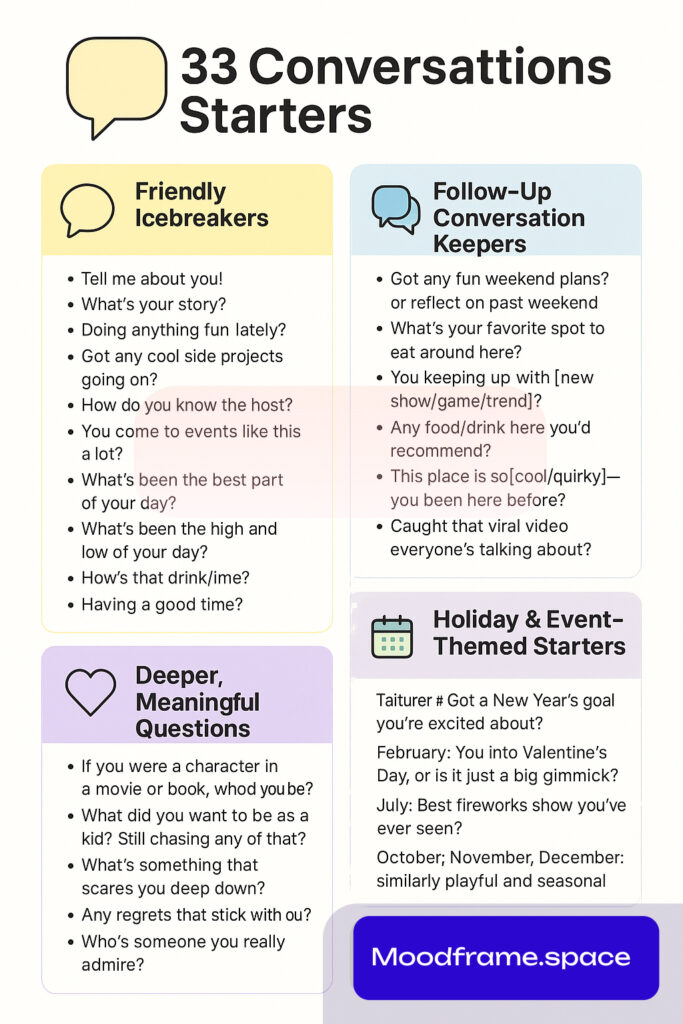
33 Killer Conversation Starters to Spark Dazzling Conversations with Anyone

conversation starters, social skills, networking tips, deep conversation questions, small talk alternatives

Want to master the art of conversation? Here are 33 killer conversation starters to help you connect with anyone, from strangers to friends, in any setting. These engaging questions ditch boring small talk like “Where are you from?” or “What do you do?” and create memorable, meaningful interactions.

Killer Openers: Break the Ice with Ease

These conversation starters are perfect for meeting someone new or reconnecting with an acquaintance, offering fresh alternatives to standard questions.

  • Tell me about you.
    this is a great one because it invites the other person to tell you something that they want to share if they want to tell you about their job they can if they want to tell you about their kids they can and it’s a great way to know what’s at the top of someone’s mind
  • Working on anything exciting recently?
    this is my alternative to what do you do asking if someone is working on anything exciting helps the other person talk about something good in their life as opposed to just giving you a boring update
  • What’s your story?
    this is an interesting conversation starter because it invites someone to tell you a story about themselves and you never know what exciting thing they might tell you
  • What personal passion project are you working on right now?
    this is one of my favorites you never know what secret side hustle someone has I love asking this one to people I already know in one context like work but would love to know more about them personally
  • How do you know the host?
    this one can be modified to any kind of event if you’re at a party hopefully you both have the host in common if you’re at a networking event or work party you can modify it – how long have you been a part of this organization
  • What was the highlight of your day today? / What was the highlight of your week?
    these are both great ones to ask instead of the standard how are you or how’s it going it also helps people share a positive story instead of just an autopilot answer of fine good
  • Have you been to an event like this before?
    this one can be modified for most types of vents from birthday parties did you come last year to networking events do you come every month
  • What was the High Point and low point of your day so far?
    this one is great if you have a talker if you’re speaking with an extrovert asking questions for them to ruminate and expand will tickle their fancy extroverts love this question
  • Has this been a busy time for you?
    I don’t always like to ask people about being busy but I use this conversation starter if someone seems distracted or not engaged sometimes acknowledging their busyness can hook them in
  • How’s that drink appetizer artwork game?
    one of my favorite context cues is asking about whatever someone is holding or doing ask them about their wine ask them if they like the artwork ask them if the food is good these are very easy openers
  • Having fun?
    a really easy cold approach opener is to look for someone who is by themselves but looks like they’re having an okay time it’s easy to sit next to someone at a table or stand next to someone at the bar and simply ask having a good time or enjoying yourself it’s a nice opener and better than just how are you

Getting Personal: Deepen the Conversation

These questions help sustain a conversation, moving from small talk to more personal topics.

  • What are you doing this weekend?
    ever had that awkward lull in a conversation this conversation starter is always welcome and if it’s a monday or tuesday you can modify to ask did you do anything fun this past weekend sometimes I also try what’s your favorite thing to do on the weekends
  • What are your favorite restaurants around here?
    I almost always ask for personal recommendations they make great conversation starters why I always get great tips and if someone doesn’t have an answer because they’re new to a city you can always talk about where they came from
  • When win keeping up with sport TV show news?
    if you’re up-to-date on news or sports you could also ask your partner if they keep up as well if so great you have a lot in common if not you can tell them about it
  • Can you recommend any unique cocktails appetizers desserts?
    another great way to get recommendations is asking what to order or grab from the buffet if they haven’t eaten yet you can go grab some food together
  • All the foods looks so good I’m not sure what to get what are you thinking or what have you tried?
    a variation of asking for recommendation is asking simply for advice on what to order even at networking events you could walk up to the bar to get recommendations
  • What a beautiful cool ugly bizarre venue have you been here before?
    one thing you will always have wherever you are is context whether you’re in a house a restaurant or a ballroom there’s always something unique to comment on and ask about
  • Did you see that viral YouTube video it was all over my social media today?
    if there is a great video or meme you just watched bring it up show them my video if they have seen it you can laugh together if they haven’t you can show them

Deep Conversation Starters: Build Stronger Connections

For longer interactions or with familiar people, these questions foster deeper, more meaningful conversations, as outlined in Captivate’s three interaction phases: first five minutes, first five hours, and first five days.

  • If you had to pick any character in a book movie or TV show who is most similar to you who would you choose why?
    this is a great one if someone has just talked about an actor or book or movie it tells you a lot about a person to hear which character they feel most like
  • When you were growing up what was your dream job is any part of that still true?
    I love asking this one any time someone has just mentioned something about their own childhood or growing up it also helps you to talk about their current job and if it’s similar to their original dream
  • What’s your biggest fear?
    ooh this one’s deep but so good it always sparks great conversation
  • What’s your biggest regret?
    talking about regret can really help you get to know someone and there past only ask this if you really want to get to know them
  • Who is your role model?
    if you’re talking about an inspiring person or boss or author you might be able to ask the person about their role model this is a great way to talk about who inspires you

Event-Specific Conversation Starters: Make It Timely

These holiday- or event-based questions add a fun, relevant spin to conversations.

  • January: what’s your new year’s resolution
  • February: do you usually celebrate Valentine’s Day do you think it’s a real or fake holiday
  • March: I went to the coolest Irish bar last st. Patrick’s Day doing anything fun this year
  • April: how long did you believe in the Easter Bunny
  • July: what’s the best fireworks display you’ve seen on the fourth of July
  • October: what’s the best Halloween costume you ever had or do you like haunted houses or scary movies
  • November: what’s your favorite Thanksgiving dinner food
  • December: how does your family celebrate for the holidays
  • Birthday-specific:
    • so the birthday person what was the highlight of your last year or what do you want to achieve for next year
    • to follow celebrators how do you usually celebrate your birthday or what was the best birthday you ever had
    • to everyone what was the best or worst birthday gift you ever received this is a great one to do around a dinner table the answers are always hilarious

Tips for Mastering Conversation Starters

  • any and all of these conversations orders will work for you if you are courageous enough to drop the boring ones and get to the good ones most people are so relieved to have you start and continue the personally
  • remember you also want to have your answers to these questions ready to go if someone doesn’t know their answer you can jump in with yours to make them feel more comfortable good luck can’t wait for you to have your next convo

Take Your Conversation Skills Further

hey I want to tell you one more thing you are amazing the question is do you know how to share it I’d love to help I saved my very best tips for my insider subscribers subscribe for free at science at people.com I know your inbox is sacred so I promise to send you only emails want more conversation tips sign up at science of people.com slash conversationalist to get our free mini course three steps to amazing conversation I want to make you an excellent conversationalist


FAQ: Common Questions About Conversation Starters

1. What are the best conversation starters for meeting new people?
Use openers like “Tell me about you” or “Working on anything exciting recently?” to invite engaging, personal responses that avoid generic small talk.

2. How can I keep a conversation going without awkward pauses?
Ask follow-up questions like “What are you doing this weekend?” or use context cues, such as “How’s that drink?” to maintain a natural flow.

3. What are deep conversation starters for building stronger connections?
Try questions like “What’s your biggest fear?” or “Who is your role model?” to transition to meaningful topics with friends or acquaintances.

4. How do I start conversations at networking events or parties?
Leverage context with questions like “How do you know the host?” or “What a cool venue, have you been here before?” to break the ice.

5. What are good conversation starters for holiday or birthday events?
Use timely questions like “What’s your New Year’s resolution?” (January) or “What was the best birthday gift you ever received?” for festive, relevant chats.

6. How do I make conversations feel natural and authentic?
Be courageous, use context (e.g., venue, food), and have your own answers ready to share, making others feel comfortable and engaged.

5 Things That Will Make a Woman Think About You Non-Stop: Unlock the Art of Introducing Yourself

make a woman think about you

Namaskar, Hi everyone, welcome back, today I’m going over things that will make a woman think about you non-stop. Most videos I’ve seen on how to build attraction come across as pretty manipulative, which I don’t like at all. So, I wanted to put a healthier spin on this: How can we naturally build attraction? How can we avoid coming on too strong? How can we leave a little to be desired? There are small shifts you can make to naturally build attraction without forcing it. At the end of the day, I want you guys to be authentic and show up as your best self. If you’re new to dating and watching videos telling you to act a certain way, it can be confusing and lead to self-sabotage. When you build attraction naturally, she can’t help but think about you when you’re apart—I’ve definitely been there! Certain things make you memorable, and we want to use what you already have to put your best foot forward. So, how do you do that? Let’s dive into my five tips!


Tip 1: Be Attentive to Make Her Feel Special

Number one is to be attentive. There are a few points here I want to touch on. First, listen and remember what she says. Being attentive to small details makes you stand out in a good way. Women are incredibly attentive to detail, so we notice when a man does this too. Be present and give her your full attention when you’re together. If you’re stuck in surface-level conversations, there’s nothing meaningful or memorable about that. Instead of thinking about what you’ll say next, listen to what she’s saying. This leads to deeper, better conversations.

The secret recipe for a memorable date is a good conversation. I’ve done an entire video on how to have a good conversation with a woman—if you don’t know where to start, check it out! I’ll link it in the description below. Be present, have deep conversations, and remember something she says. Bring it up later when texting or the next time you see her, and she’ll be impressed. It shows you’re genuinely interested and makes you stand out.


Tip 2: Be Independent to Build Attraction

Number two: Independent equals attractive. The last thing you want is to be needy or clingy—it’s a surefire way to kill attraction and send her running. Have your own life going on—your own purpose, passions, hobbies, and interests. You shouldn’t rely on others to provide that for you. As a woman, it’s incredibly attractive when a man has his purpose and passions, enjoys what he does, and shares that with you. The more aligned you are with what brings you joy, the less needy you’ll be because you know you’re fine on your own.

If you’re good at something or enjoy certain activities, don’t be afraid to share that—it’s attractive when a guy is skillful or interesting. I’ve done a video on how to be more interesting, and a key point is to do more things in life—it makes you more engaging! Another aspect of independence is having boundaries. Know you wouldn’t drop everything to see her. That sounds romantic in movies, but it’s not healthy early on. For example, if you’re a busy guy focused on work but make time for her after work on Friday, it shows you prioritize her without neglecting your life. She’ll think, “Wow, he’s busy but made time for me—I must be important.” That’s a great sign and makes you memorable.


Tip 3: Be a Gentleman to Stand Out

Number three: Be a gentleman. If you’re pursuing a girl, being a gentleman makes you stand out in the best way. She’ll remember small gestures like opening the door or giving her your jacket when she’s cold. These seem small but are incredibly meaningful. For example, on one of my first dates with my boyfriend, we were walking to a coffee shop, and I was cold. He gave me his scarf—I still have it three years later, and I’ve never forgotten that moment. I promise, she’ll remember these gestures years later. Being a gentleman makes you unforgettable and shows you care.


Tip 4: Give Non-Physical Compliments

Number four: Non-physical compliments. Compliments should be genuine—don’t lie to get someone to like you. The best compliments aren’t always about appearance. If she’s attractive, she likely hears “You’re so hot” all the time. Stand out by complimenting something else: “I love your energy,” “You’re so down-to-earth,” “You’re super smart,” or “I love how passionate you are about [topic].” These are memorable because they’re unique. I get flattered by any compliment, but the ones that stand out on my YouTube videos are about how I speak or my knowledge, not my looks. Those mean the most because they’re about what I’m proud of. Focus on non-physical compliments, and she’ll remember them.


Tip 5: Try Something New Together

Number five: Try something new together. We can get caught up in routines, so doing something different feels refreshing. Go on a date you’ve never tried or do something neither of you has done before—it’s less predictable and more fun and memorable. It’s a great way to bond and build a deeper connection because you’re both learning together. If you take her to a cooking class she’s never done and you have an incredible time, she’ll think about it later. I’m a routine, Type-A person, but doing something new adds a memorable factor.

Being spontaneous and thinking on your feet is also attractive. On my first date with my boyfriend, we planned brunch, but it went so well that he suggested we keep going. We went shopping, and it was fun and memorable. In a video I did with a group of girls, every one said their best first date involved a guy being spontaneous and thinking on his feet. It shows confidence, reliability, and the ability to take the lead—qualities women find attractive. You don’t need to go skydiving, but don’t be afraid to try something new to build attraction.


Final Thoughts: Be Your Best Self

That’s my list of five things that will make a woman think about you non-stop. Unlike manipulative tactics or psychology tricks, these tips are about showing up as the best version of yourself. You don’t need to trick someone or be someone you’re not. If you’re new to dating, feel like you’re self-sabotaging, or want to make a great first impression, these are a great place to start. I hope you found this helpful! If you did, give it a thumbs up and subscribe to stay in the loop for new content. Follow me on Instagram at @moodframespace—I love connecting with you there!

In the comments, let me know:

  • What do you think of these dating tips?
  • Any first date stories or tips you’d add?
  • Have you tried being spontaneous on a date?

Thanks for watching, and I’ll see you next time!


FAQ: Common Questions About Building Attraction

Q: How do I make a woman think about me after a date?
A: Be attentive, listen to her, and remember small details to bring up later. Stay independent, show your passions, and be a gentleman with thoughtful gestures. Non-physical compliments and trying new activities together also make you memorable.

Q: How can I build attraction naturally?
A: Focus on being your authentic self—listen actively, have your own life and boundaries, give genuine compliments, and try fun, new experiences together. Avoid manipulative tactics and prioritize connection.

Q: What are some memorable first date ideas?
A: Try something new like a cooking class, a unique café, or a fun activity neither of you has done. Spontaneity, like extending a great date with a walk or new plan, also creates lasting memories.

Top 5 Best First Date Tips For Men

First Date

Namaskar, I’m sharing how to have a great first date. Today, I’m sharing five tips for a successful first date to ensure you leave feeling confident, regardless of the outcome. Follow these tips, and you won’t be thinking, “I could have done this better.” Let’s jump into it!


Tip 1: Dress Well for Your First Date

Number one on my list is to dress well. I’m not saying dress like someone you’re not or wear what you think she wants. If you buy an outfit just for the first date and don’t have similar clothes for a second date, she might notice you dressed to impress in a way that’s not your style. When I say dress well, I mean dress like the best version of yourself. This depends on the date setting:

  • For a casual brunch on the weekend, go for jeans, sneakers, and a nice shirt to fit the vibe.
  • For after-work drinks or dinner, maybe lean toward business casual.

I won’t get super specific about outfits since that’s a whole video on its own. If you want me to cover what to wear on a first date, let me know in the comments! Just dress for the setting—don’t try too hard with a full suit unless you’re hitting a gala, which I wouldn’t recommend for a first date anyway. Look like you put in effort, not like you rolled out of bed. If a guy shows up in a stretched-out V-neck looking hungover, it’s an instant turnoff. First impressions are key, so make a good one!


Tip 2: Pick the Perfect First Date Location

Next, pick the perfect place. This varies based on where you live and the season. In California, where it’s sunny and 75° year-round, you have more options than in Cleveland, where it’s cold seven months of the year and winter activities are limited. Choose a public setting where you can get to know each other without revealing too much too soon. I don’t recommend inviting her to your place on the first date—it shows all your cards and leaves no mystery.

Go somewhere casual and fun where you can talk one-on-one. A fancy dinner date isn’t ideal for a first date. If you realize 20 minutes in that you don’t click, you’re stuck in a four-course meal with someone you don’t like, and you’re footing the bill. Plus, flashing too much money might attract the wrong type of person. Avoid places like movies for a first date with someone you’ve never met. Sitting in silence for two hours sharing popcorn is awkward and kills any chance to connect. If you’re already friends, a movie’s fine, but for online matches, stick to conversation-friendly spots like a café or a relaxed restaurant.


Tip 3: Master First Date Conversation

Conversation is arguably the most important part of a first date. Get to know her—what she’s into, who she is—but she should be curious about you too. If she’s not asking you anything, it might mean she’s not interested, and that’s okay. Not every date will be a match. If you’ve checked her Instagram and know things you shouldn’t, don’t ask questions to seem impressive or robotic. Be candid, go with the flow, and notice what she lights up about. Focus on those topics and see if you share common interests.

Don’t talk about yourself the whole time—I’ve been on dates where the guy did this, and it’s awkward and unenjoyable. If you’re asking all the questions and getting nothing back, it’s a turnoff. Show curiosity if you’re interested. After the date, ask yourself: Do I want to know more about her? Are we compatible? Is a second date worth it? A good first date conversation in the right setting helps you figure this out.


Tip 4: Know When to End or Continue the Date

My next tip is knowing when to stop or continue the date. This is why a public place with a natural endpoint, like brunch, is ideal. When the bill’s paid and you’ve chatted a bit, decide: Do I want to keep going, or am I ready to call it? If you’re not feeling it or sense she’s done, be polite, say you had a nice time, and part ways. But if you’re both having fun, be spontaneous! Suggest something else, like a walk or a quick activity.

On my first date with Teddy, we clicked instantly at brunch. Neither of us wanted it to end, so he invited me to go shopping with him at an outdoor mall. We walked, talked, and I learned so much more about him in that relaxed setting. It was attractive that he thought on his feet and showed interest. Spontaneity can turn a good date into a great one, maybe even a full day that leads to years together!

Another thing: Pay the bill on the first date. I have traditional values, and I find it attractive when a guy takes initiative. It avoids awkward moments when the bill arrives. Teddy and I now split bills sometimes, but on the first date, grabbing the check is a confident move.


Tip 5: Be Clear About Next Steps

Finally, be clear about next steps. If you don’t want a second date, don’t say you do. Be polite, but don’t lead her on, especially if you’re both looking for something serious. If you’re unsure, don’t commit right away—go home, think it over, and decide later. Don’t seem too eager or overly available; it can set unrealistic expectations. But if you’re into her, let her know. At the end of my 12-hour date with Teddy, he said, “I’d love to see you again,” and it felt great knowing we were on the same page.

Now, the dreaded after-date text. As a girl, we overthink this—should I text him? Should I wait? Guys, if you had a great time, text her when you get home. Say, “Had a great time tonight, it was awesome meeting you!” It’s confident and stops her from stressing. Don’t rush to plan the next date, but if she responds with similar energy, you can suggest a second date later. For example: “Hey, had a great time today. I don’t know what your week looks like, but I’d love to see you again.” This shows interest without being pushy. Sincerity beats games when you’re looking for a quality connection.


Wrap-Up: Make Your First Date Unforgettable

That’s my list of five tips for a great first date! I hope you found this helpful. If you did, give it a thumbs up—I love connecting with you there and putting faces to the comments!

In the comments below, let me know:

  • What do you think of these first date tips?
  • Did I miss anything, or do you disagree?
  • Share your first date stories—mistakes you made or learned from. They’re fun and help us all grow!

Thank you so much for reading, and I’ll see you next time!


Is It Normal for a Man to Directly Ask for Intimacy on a First Date?

When It’s Okay to Discuss Intimacy

In the ever-evolving world of modern dating, questions about boundaries, expectations, and appropriate behavior often arise, especially when it comes to sensitive topics like intimacy. One question that frequently surfaces is: Is it normal for a man to directly ask for intimacy on a first date? This topic sparks curiosity, debate, and sometimes discomfort, as it touches on issues of communication, consent, cultural norms, and personal boundaries. As a professional psychologist with extensive experience in relationship dynamics, I aim to provide a detailed, empathetic, and evidence-based exploration of this question to help readers navigate the complexities of first-date interactions.


1. Understanding the Question: What Does “Normal” Mean in This Context?

When we ask whether it’s “normal” for a man to directly request intimacy on a first date, we’re really asking about acceptability, frequency, and appropriateness within the context of modern dating. “Normal” is a subjective term, heavily influenced by personal values, cultural backgrounds, and individual expectations. For some, a direct request might feel bold and honest; for others, it may come across as inappropriate or disrespectful.

From a psychological perspective, “normal” behavior aligns with societal norms, personal boundaries, and mutual comfort. However, dating norms are not universal. What’s considered acceptable in one context (e.g., a casual dating app encounter) may be inappropriate in another (e.g., a date arranged through mutual friends). To answer this question thoroughly, we need to explore the motivations behind such requests, the context in which they occur, and how they’re received.

“Normal” depends on the individuals involved, their expectations, and the context of the date. Understanding this subjectivity is the first step to navigating first-date dynamics.


2. The Psychology Behind Asking for Intimacy on a First Date

Communication Styles and Gender Expectations

Men and women often face different societal pressures when it comes to dating communication. Men, in particular, may feel compelled to take the lead or express interest assertively due to traditional gender roles. In some cases, a man might ask for intimacy directly because he perceives it as a confident or transparent move, aligning with cultural narratives that reward boldness in male behavior.

However, communication styles vary widely. Some individuals prefer directness, while others value subtlety and gradual connection-building. A man who asks for intimacy on a first date may be operating from a direct communication style, but this doesn’t necessarily mean his intentions are disrespectful. Understanding his communication approach can provide insight into his motivations.

Motivations Behind Direct Requests

There are several reasons a man might ask for intimacy on a first date:

  • Honesty About Intentions: He may want to clarify that he’s seeking a physical connection, possibly to avoid leading his date on if their goals don’t align.
  • Misreading Signals: He might misinterpret friendliness or flirtation as an invitation to discuss intimacy.
  • Cultural or Social Conditioning: In some social circles or dating app cultures, directness about physical desires is more common.
  • Lack of Social Awareness: Some individuals may not realize that such a request could make their date uncomfortable.
  • Entitlement or Pressure: In less healthy cases, a man might feel entitled to intimacy or believe it’s expected based on societal stereotypes or past experiences.

The Role of Confidence vs. Entitlement

Confidence and entitlement can sometimes be confused. A confident man might express interest in a respectful, consensual way, gauging his date’s comfort level. Entitlement, on the other hand, disregards boundaries and assumes reciprocation. Distinguishing between these two is critical when evaluating a first-date interaction.

Research suggests that men are more likely to overestimate sexual interest from women due to evolutionary and social factors (Buss & Schmitt, 1993). This misperception can lead to premature or direct requests for intimacy, especially in early dating stages.


3. Cultural and Social Influences on First-Date Behavior

Dating Norms Across Cultures

Dating etiquette varies significantly across cultures. In some Western cultures, particularly in urban settings, casual dating and open discussions about physical attraction are more accepted. In contrast, in more traditional or collectivist societies, such as parts of Asia or the Middle East, discussing intimacy on a first date may be considered highly inappropriate or even taboo.

For example, in the United States, dating app culture has normalized faster-paced interactions, with some individuals feeling comfortable discussing physical desires early. In contrast, in countries like Japan, dating often involves a slower, more formal process, where intimacy discussions are reserved for later stages.

The Impact of Media and Dating Apps

Media portrayals of dating, from rom-coms to reality TV, often depict men as bold initiators of physical intimacy. Dating apps like Tinder or Bumble, which prioritize quick connections, can amplify this dynamic, creating an environment where directness is sometimes expected. According to a 2022 study by Pew Research, 59% of dating app users report encountering conversations about physical intimacy early in their interactions, suggesting it’s not uncommon in certain contexts.

Generational Differences in Dating Expectations

Millennials and Gen Z often have different approaches to dating compared to older generations. Younger daters, influenced by hookup culture and digital communication, may be more open to discussing intimacy early, while older generations might prioritize emotional connection first. Understanding these generational nuances can help contextualize a man’s behavior on a first date.

Cultural and social factors heavily influence what’s considered “normal” in dating. Being aware of these influences can help you interpret and respond to a man’s request for intimacy.


4. Is It Normal? A Statistical and Psychological Perspective

Prevalence of Intimacy Discussions on First Dates

While exact statistics on men asking for intimacy on first dates are limited, studies on dating behavior provide some context. A 2021 survey by Match.com found that 34% of singles reported discussing physical attraction or expectations within the first two dates, with men being slightly more likely to initiate these conversations. This suggests that while not universal, such discussions are not rare, particularly in casual dating scenarios.

Psychological Implications of Early Intimacy Requests

From a psychological standpoint, asking for intimacy on a first date can have varied implications:

  • For the Asker: It may reflect confidence, a desire for transparency, or a lack of emotional awareness. In some cases, it could indicate impulsivity or unrealistic expectations.
  • For the Recipient: The request might trigger discomfort, pressure, or confusion, especially if it feels premature. However, if handled respectfully, it could also open a dialogue about mutual expectations.

A 2020 study in the Journal of Social and Personal Relationships found that early discussions of physical intimacy were associated with higher relationship satisfaction when both parties felt comfortable and respected, but lower satisfaction when boundaries were crossed.


5. Consent and Boundaries: The Cornerstone of Healthy Interactions

Why Consent Matters on a First Date

Consent is non-negotiable in any romantic or physical interaction. A man asking for intimacy on a first date is not inherently problematic, provided the request is made respectfully and with an openness to hearing “no.” Consent requires clear, enthusiastic agreement from both parties, free from coercion or pressure.

Setting and Communicating Boundaries

If a man asks for intimacy and you’re uncomfortable, it’s essential to communicate your boundaries clearly. For example:

  • Direct Response: “I appreciate your honesty, but I’m not comfortable discussing or pursuing intimacy this early.”
  • Redirecting the Conversation: “I’d love to get to know you better first. What are some things you’re passionate about?”

Setting boundaries early establishes mutual respect and helps gauge whether your date values your comfort.

Red Flags to Watch For

While a direct request isn’t always a red flag, certain behaviors are cause for concern:

  • Ignoring Your Response: If he persists after you say no, this indicates a lack of respect for your boundaries.
  • Pressure or Guilt-Tripping: Statements like “You’re being too uptight” or “I thought you were open-minded” are manipulative.
  • Disrespectful Tone: A dismissive or entitled attitude suggests deeper issues with empathy or respect.

Healthy relationships are built on mutual respect and emotional safety. Early boundary violations can predict future challenges in a relationship (Gottman, 1999).


6. How to Respond if a Man Asks for Intimacy on a First Date

Assertive Communication Strategies

Responding to a direct request for intimacy requires confidence and clarity. Here are some strategies:

  • Acknowledge and Redirect: “I hear you, but I’d rather focus on getting to know each other first.”
  • Set a Firm Boundary: “I’m not comfortable with that right now, and I’d appreciate it if we could keep things light.”
  • Ask Questions: “What made you feel comfortable asking that?” This can open a dialogue and reveal his intentions.

Evaluating Compatibility and Intentions

A man’s request for intimacy can provide insight into his goals. Is he seeking a casual fling, or is he testing the waters for a deeper connection? Asking clarifying questions like “What are you looking for in a relationship?” can help you determine if your values align.

Maintaining Your Comfort and Safety

Your comfort and safety are paramount. If the request feels overwhelming, it’s okay to end the date early or take a step back. Trust your instincts—if something feels off, prioritize your well-being.

Pro Tip: Practice assertive communication in low-stakes settings to build confidence for handling unexpected situations on dates.


7. The Role of Gender Dynamics in Dating Expectations

Societal Pressures on Men and Women

Gender norms often place pressure on men to be assertive or dominant in dating, while women are expected to be more reserved. These stereotypes can lead to misunderstandings, such as a man feeling obligated to make a bold move or a woman feeling pressured to comply to avoid conflict.

Breaking Down Stereotypes

Challenging these stereotypes involves open communication and mutual respect. Both men and women benefit when dating is approached as a collaborative, egalitarian process rather than a scripted performance of gender roles.

Gender dynamics influence dating behavior, but prioritizing authenticity and respect can create healthier interactions.


8. Building Healthy Connections: Alternatives to Premature Intimacy Requests

Fostering Emotional Intimacy First

Emotional intimacy—built through shared values, meaningful conversations, and mutual vulnerability—often lays a stronger foundation for a relationship than physical intimacy. Encourage activities like discussing shared interests, exploring each other’s goals, or engaging in lighthearted, playful banter.

Creating a Respectful First-Date Environment

To foster respect on a first date:

  • Choose a Neutral Setting: Public places like cafes or parks create a low-pressure environment.
  • Focus on Connection: Ask open-ended questions to build rapport.
  • Respect Pace: Allow the relationship to unfold naturally without rushing to physical or emotional milestones.

9. When It’s Okay to Discuss Intimacy: Timing and Context

Mutual Interest and Comfort Levels

Discussing intimacy is appropriate when both parties feel comfortable and have established mutual interest. Signs of readiness include:

  • Open, honest communication about relationship goals.
  • A sense of trust and emotional connection.
  • Mutual respect for each other’s boundaries.

Signs of a Healthy Conversation About Intimacy

A healthy discussion about intimacy is:

  • Respectful: Both parties feel heard and valued.
  • Consensual: No one feels pressured to agree.
  • Context-Appropriate: The conversation aligns with the stage of the relationship.

Psychological Insight: Couples who prioritize emotional intimacy before physical intimacy report higher relationship satisfaction and longevity (Markman et al., 2010).


10. FAQs About Intimacy on First Dates

Q: Is it a red flag if a man asks for intimacy on a first date?
A: Not necessarily, but it depends on how the request is made and how he responds to your boundaries. If he respects your comfort level and doesn’t pressure you, it may simply reflect his communication style. However, persistent or disrespectful behavior is a red flag.

Q: How do I say no without making things awkward?
A: Be clear and kind: “I’m not comfortable with that right now, but I’m enjoying getting to know you.” Redirect the conversation to a neutral topic to maintain a positive vibe.

Q: What if I’m interested in intimacy but not on the first date?
A: Communicate your interest while setting a timeline that feels right: “I’m open to that down the line, but I’d like to take things slow and build a connection first.”

Q: Does asking for intimacy mean he’s only interested in something casual?
A: Not always. Some people use directness to clarify intentions. Ask about his relationship goals to understand his motivations better.

Q: How can I tell if he respects my boundaries?
A: A respectful partner will acknowledge your response, not push back, and adjust their behavior to ensure your comfort.

Q: Are men more likely to ask for intimacy than women on first dates?
A: Research suggests men are more likely to initiate conversations about physical intimacy due to socialized gender roles, but individual differences vary widely.

Q: How do I rebuild trust after an uncomfortable first-date moment?
A: Open communication is key. Discuss how the moment made you feel and assess whether he’s willing to respect your boundaries moving forward.

Q: Is it okay to end a date if I feel pressured?
A: Absolutely. Your safety and comfort come first. Politely excuse yourself if you feel uneasy.

Q: How do dating apps influence first-date intimacy expectations?
A: Dating apps can create a fast-paced environment where physical attraction is prioritized, but clear communication about expectations can help align goals.

Q: Can a relationship work if intimacy is discussed too early?
A: Yes, if both parties communicate openly, respect boundaries, and share compatible goals. Early discussions don’t have to derail a connection.


The question of whether it’s normal for a man to ask for intimacy on a first date directly doesn’t have a one-size-fits-all answer. Individual personalities, cultural norms, and the context of the date shape it. While such a request isn’t inherently wrong, it’s critical to prioritise consent, respect, and mutual comfort. By understanding the psychological and social factors at play, setting clear boundaries, and fostering open communication, you can navigate first-date dynamics with confidence and clarity.

Whether you’re exploring modern dating or seeking to build meaningful connections, remember that healthy relationships are rooted in mutual respect and emotional safety. If a man’s request for intimacy feels premature, trust your instincts, communicate your needs, and prioritize your well-being. Dating is a journey, and each interaction offers an opportunity to learn more about yourself and what you value in a partner.